
Why do I write it down?

[a short post today, about books in the works, a book I’ve been poring over and some navel-gazing sort of woodworking. I’ve made this one for all subscribers to give those who only see the previews a look at what I’m up to…support from the readers of this blog has had a huge impact on my work. It’s greatly appreciated.]
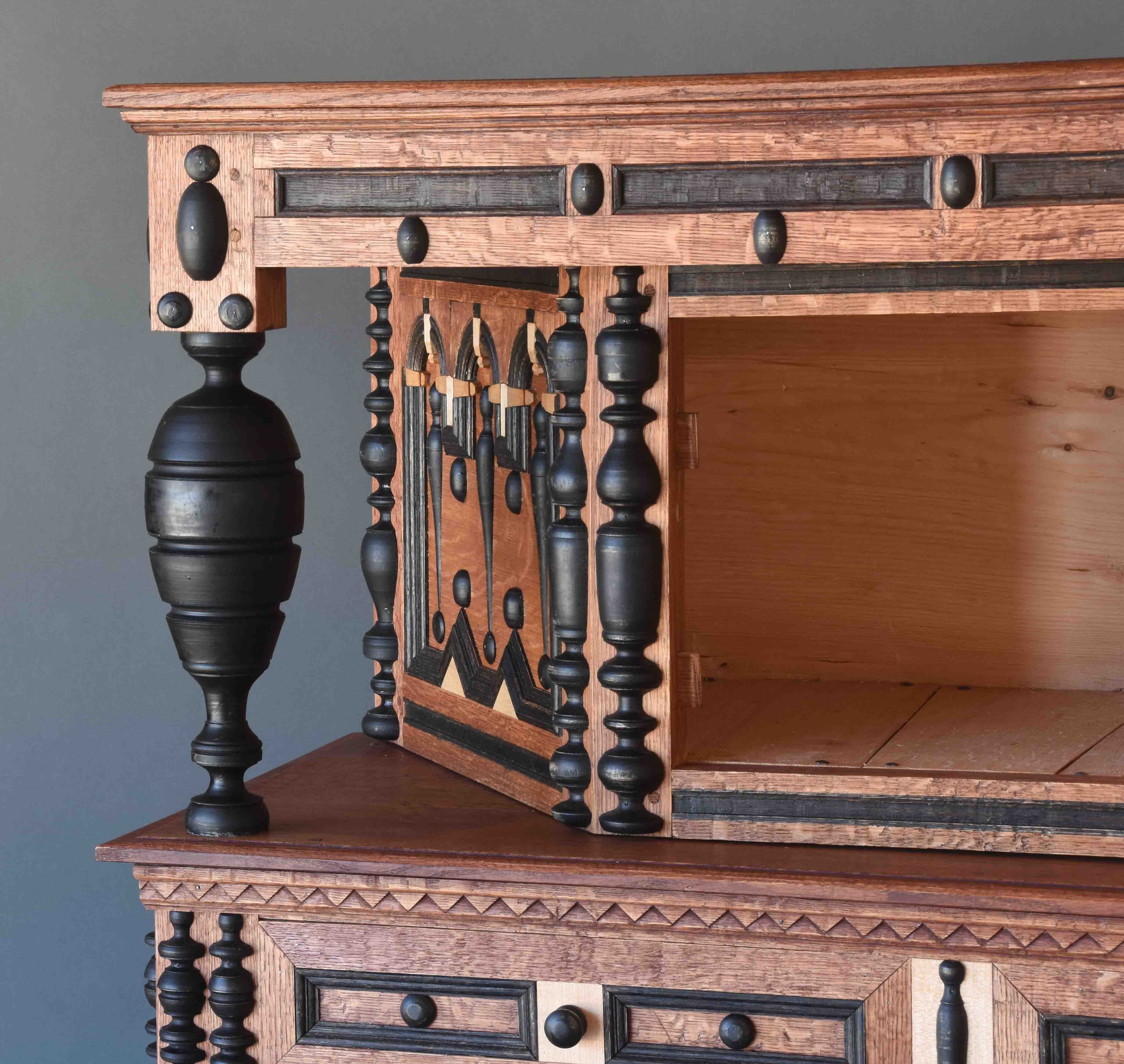
I was thinking of Clair Franklin Luther (1866-1938) the other day. I spent a couple of days this week working on the text for my book about building the Essex County cupboards. (With Lost Art Press, of course - who else? https://LostArtPress.com
Megan Fitzpatrick went over it some time ago and sent it back to me. I picked away at it for a while. Then this week I got serious & I think I finished it. I’m sure Megan will let me know if I have more work to do.
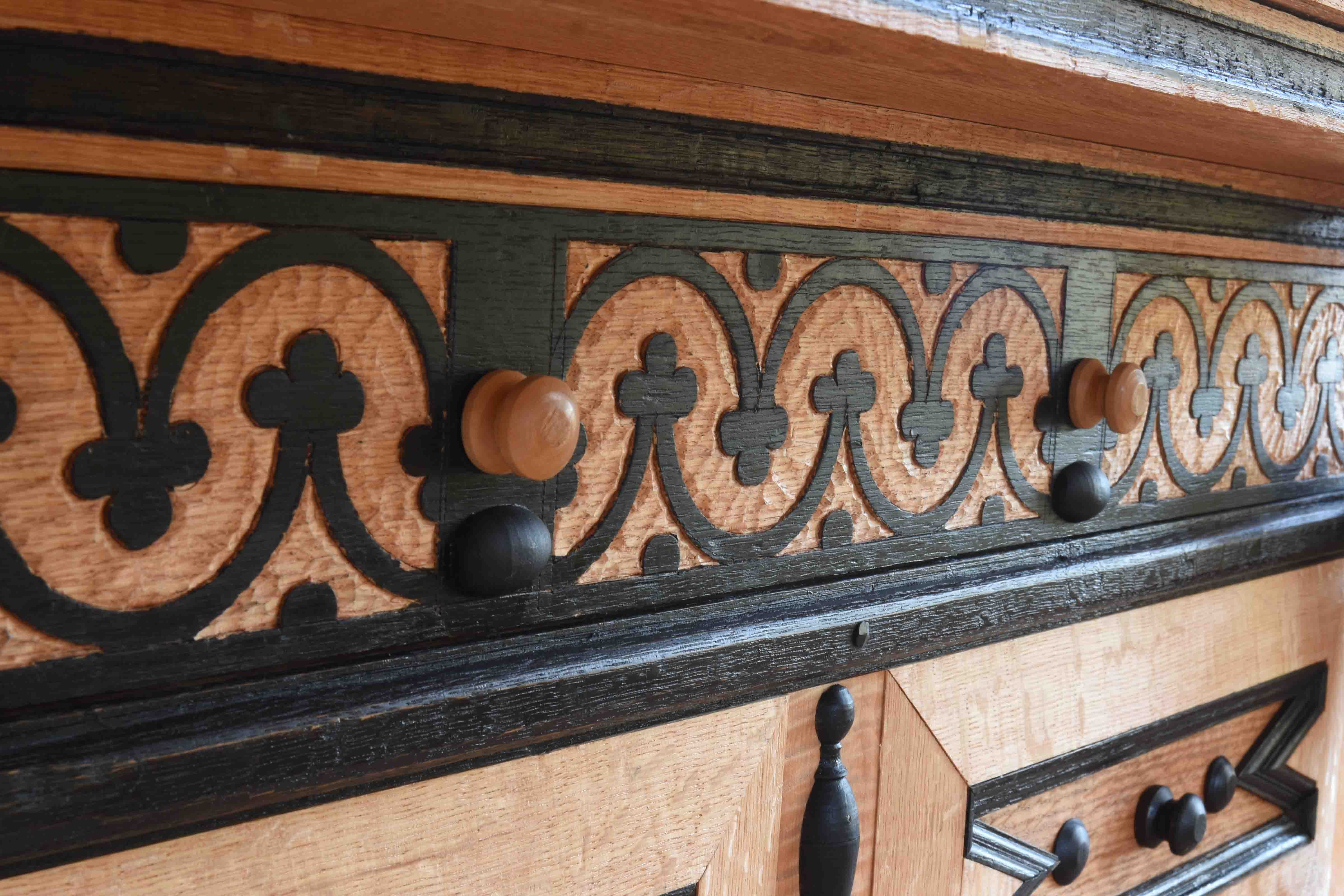
The world doesn’t need a how-to book about building these cupboards. They’re not the sort of thing that many households need - I tend to specialize in making stuff nobody needs. But - I didn’t want to write the book so hundreds and hundreds of people would go out & build these things. You will be able to build one with the information in the book - if you were so inclined. You’d be in for a lot of work, but a lot of satisfaction when finished. But my main intention was to create a record of what “we” have pulled together in the late 20th/early 21st century about the joinery traditions of New England in the 17th century.
Which is why I was thinking about Luther. He’s an interesting character. You’d probably only know his name if you were fanatical about studying New England oak furniture. His book The Hadley Chest (Harford, CT.: Case, Lockwood & Brainard Co., 1935) is a study of a large group of chests made in western Massachusetts and down into Connecticut. I wrote about Hadley chests a bit last year https://peterfollansbeejoinerswork.substack.com/p/hadley-chests
In real life he was minister of the Second Congregational Church of Amherst, Massachusetts. But he became fascinated by these local chests and spent a great deal of time tracking them down, studying & photographing them for his book. But Luther didn’t just study them, he made one. His chapter 9 is entitled “Making a Hadley Chest.”
“There is nothing startling about it, nothing exceptional, beyond the fact indeed, that such an experience does put one in position to speak with clearer understanding of the process and so enter more intimately into the situation of the early builders. When one has actually gone through the paces, handled the tools, rived the lumber, traced the design and assembled the parts, repeating the processes one by one, in so doing he has entered into the House of the Interpreter of the forgotten past and became kith and kin with the Unknown.”
Searching the internet, I learned that his father was a carpenter in Painesville, Ohio. I assume that’s where Clair got his knack for woodwork. He recounts how a dealer in antiques saw some of his “handiwork” and told him “you should make a Hadley chest.” Which meant nothing to him at the time. But he soon got hooked. His book notes the date he examined each chest in it and he says the earliest was 1921, though he then realized he had seen one in the 1880s when visiting the Deerfield (Massachusetts) Museum. He wrote about how he and his daughter:
“took measurements and rubbings of every part of the chest, with notes as to details of construction. Even so the specifications were not complete, for as the structure grew it became necessary to re-visit the Museum to secure more complete details relating to parts we had overlooked.”
This “whoops, I overlooked something...” has happened to me an astounding number of times, from my first examination of a period piece to my most-recent I’m sure. It’s pretty hard to get all the information you might need in one session. For the cupboards I made - I had my own extensive notes and those from two other joiners I know, Rob Tarule and Ted Curtin. I’ve known them since my earliest days studying oak furniture. When Jennie Alexander & I were just starting to make repros of 17th century work, Rob and Ted were the only people we ever heard of who knew anything about working that way. I eventually collaborated with them on a related cupboard, now at the Saugus Iron Works in Saugus, Massachusetts.
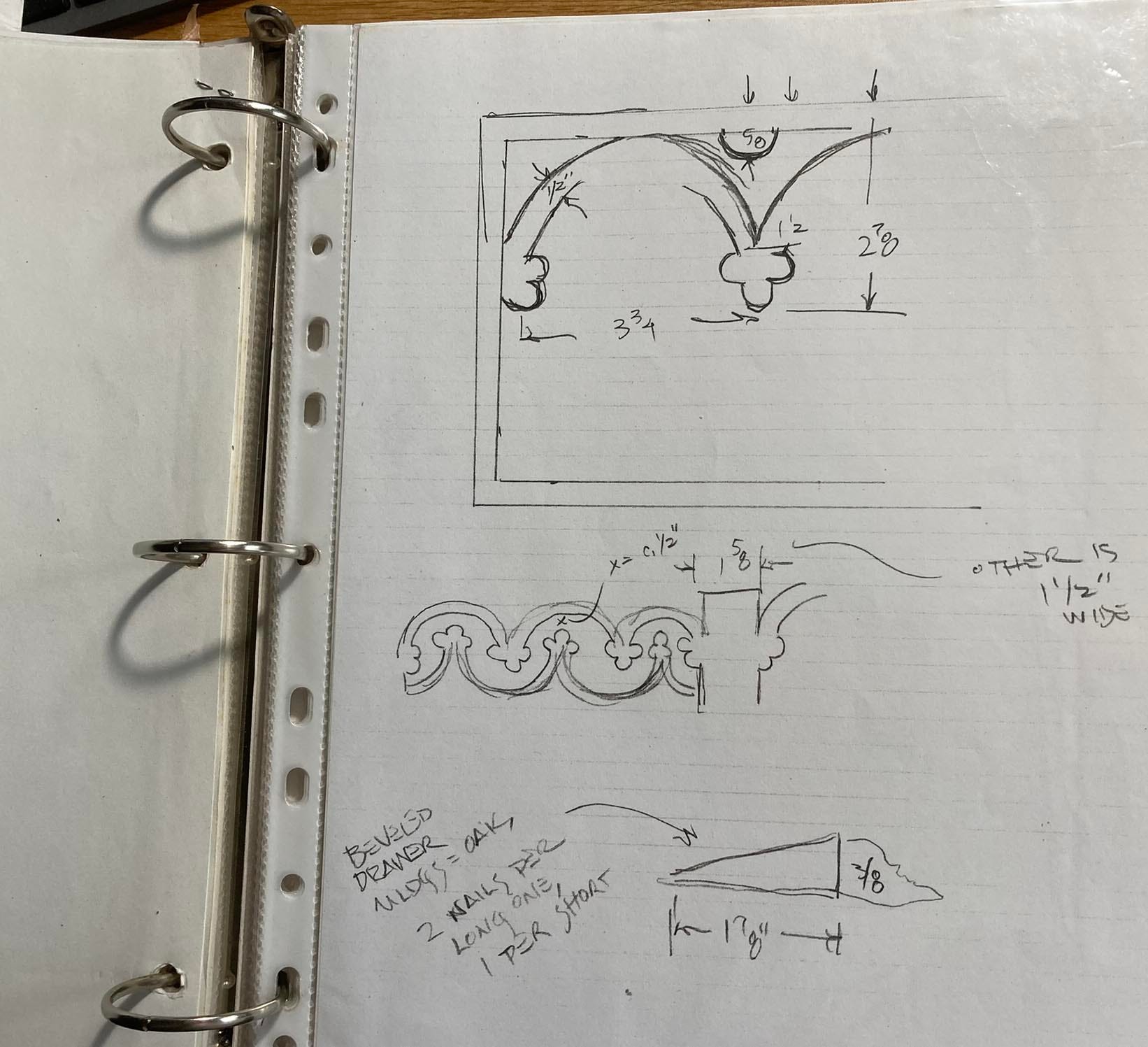
But even with all our notes, I still went back to the Massachusetts Historical Society to check a few things when I started in on the two versions in the book. And still came away with more questions. I hope to never run out of questions.
Luther continues - writing about gathering the material to build his chest and he mentions how the nails had to be “hand-wrought” and then goes even further:
“In order to follow the original processes as closely as possible, the oak parts should have been hand-rived from unsawed logs. I may as well confess that not all the parts were so obtained. The wide panels were taken from seasoned boards...But many of the rails and stiles were actually split out with axe and wedge, and reduced to form by hewing, shaving and planing, exactly as builders of the 17th century did the work. There is a comradeship in this which cannot be found in machines, and introduces one to methods and difficulties unknown to the factory.”
When I build a chest (or most any joined work) I shift through several test-assemblies. These usually provide me with some critical dimensions that I prefer to get by scribing rather than measuring. But there’s also that impatient “what’s it going to look like?” urge.
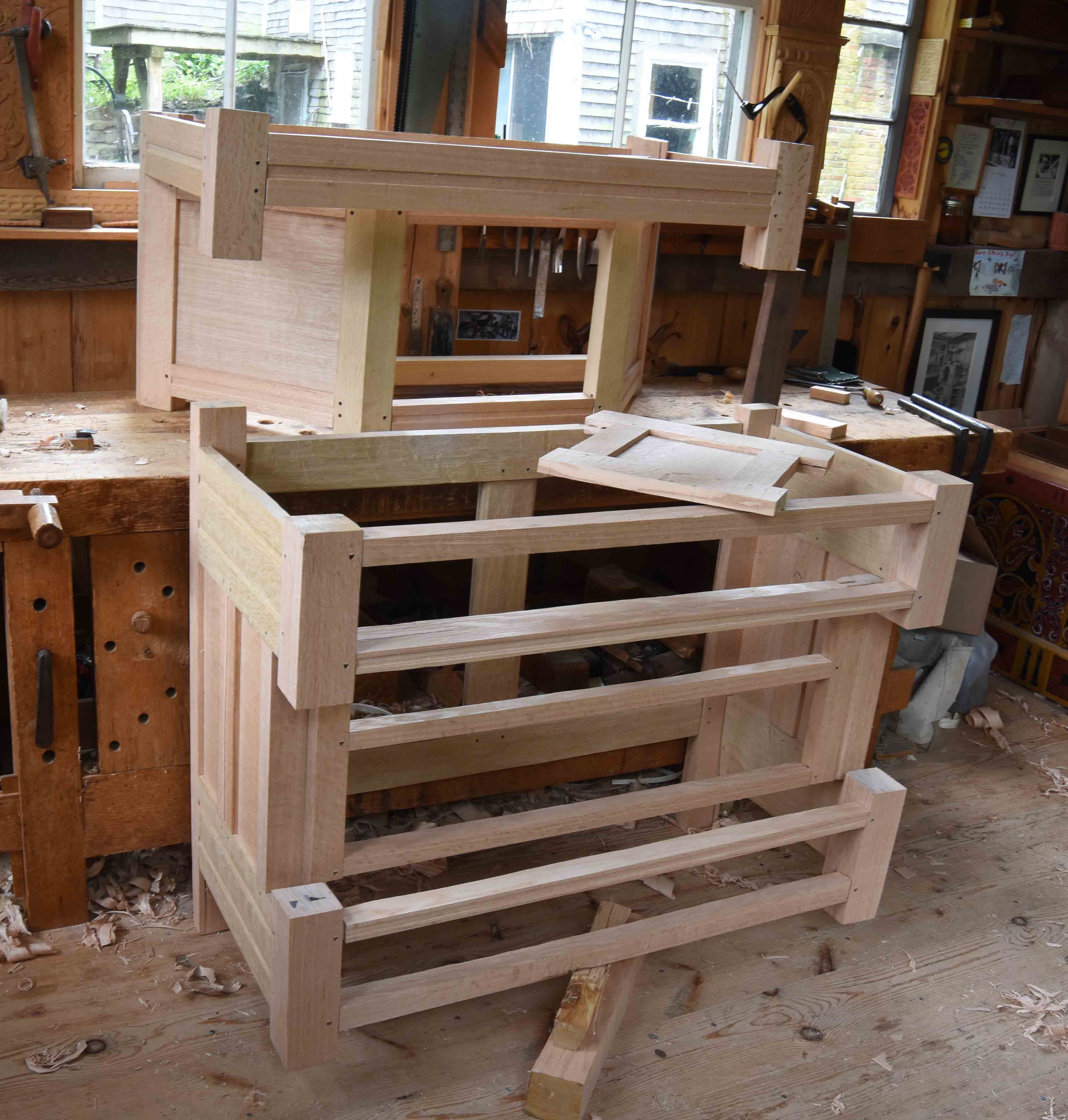
I’ve seen students do the same thing with their carved boxes - mock up the parts before actually being at the point of assembly. Luther did it too.
“The work progressed day by day, with various interruptions and it was really a proud moment when the carved parts of the front could be assembled and show something of what the completed work was to be.”
Even after all these years, I still stand back to imagine the finished work from these test-assemblies. I can’t help it. When discussing the amount of time spent on his reproduction, Luther notes that it was shorter than expected. He mentions
“three Hartford chests that bear the date 1700 do not necessarily display any exceptional speed on the part of the maker. He might have doubled his output and still have had time to catch shad at the spring run.”
His repro of the Rebecca Allis chest is included in the book -
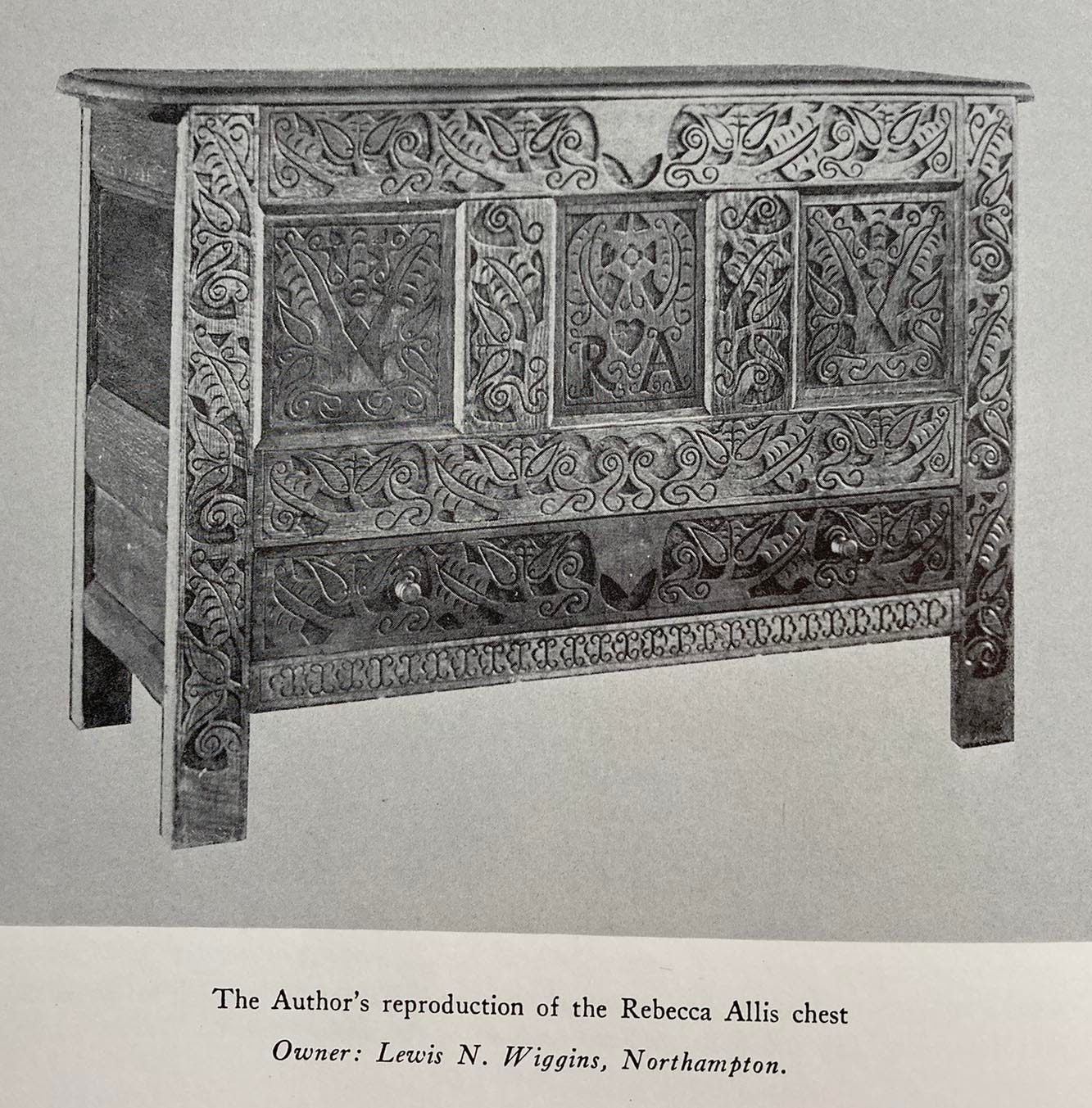
Above I wrote that Luther “made one.” What I didn’t know until sitting down to write this post is that there were others. Historic Deerfield has a different one on their website -
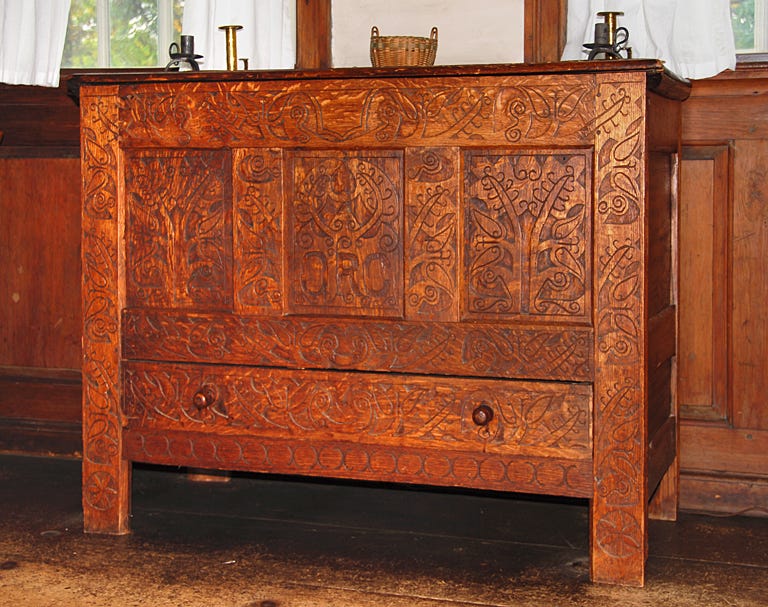
And their text for this chest says: “Luther researched Connecticut River Valley antique furniture and reproduced examples, such as this chest, using antique tools, methods and materials in his basement workshop.” See the full catalog entry here:
ttps://museums.fivecolleges.edu/detail.php?t=objects&type=ext&id_number=HD+2006.19
It’s funny, I don’t remember much about Luther when JA & I were first mucking about with fresh oak logs. I forget when I learned about his woodworking. The Hadley chests have only been peripheral to my study, their carving doesn’t appeal to me very much. I’m most interested in them for their excellent construction, they’re expertly joined.
I don’t know how many chests Luther built, he died just a few years after his book was published. But imagine if he had written more about his woodworking, about making his chests. Maybe that would have jump-started the likes of JA & me, Tarule & Curtin…
Or maybe it was better the way it shook out. Forcing us to learn from the surviving works. Regardless of what might have been, my purpose in writing the particular book about the cupboards is to have a record of how one 20th/21st-century joiner undertook the task of reverse-engineering a complex 17th century furniture form. Someone years from now can decide I was completely off-base and take on the work from a whole different angle.
My next next book has a similar motive. That’s my Craft Genealogy project. I’ve shelved it for quite a while, but now I’ll pick it up again. That book will serve too as a record. Someone asked me “who’s the audience?” I told them I don’t care who the audience is, my purpose is to record what I know about the people who influenced me, to get their stories down in writing so their impact is known after we’re all gone.
It’s not a broad history of green woodworking in America. Instead a deliberately very narrow scope - just the woodworkers who directly influenced me, how they learned their crafts themselves, how they came together to impact each other and then spread out from there, reaching hundreds, probably thousands of woodworkers during the second half of the twentieth century. I don’t want those stories to get away…
That’s enough. Time for Luther’s book to go back on the shelf and for me to get to the shop.
PS: Luther’s book is online here maybe only available in the US - https://babel.hathitrust.org/cgi/pt?id=inu.30000108973532&seq=29
A stand against “Everyone who knows is dead.” Well done.
I love that line "There is a comradeship in this which cannot be found in machines". All of us who have embarked upon making a riven oak chest. It is a journey, to be sure, one we have all shared.