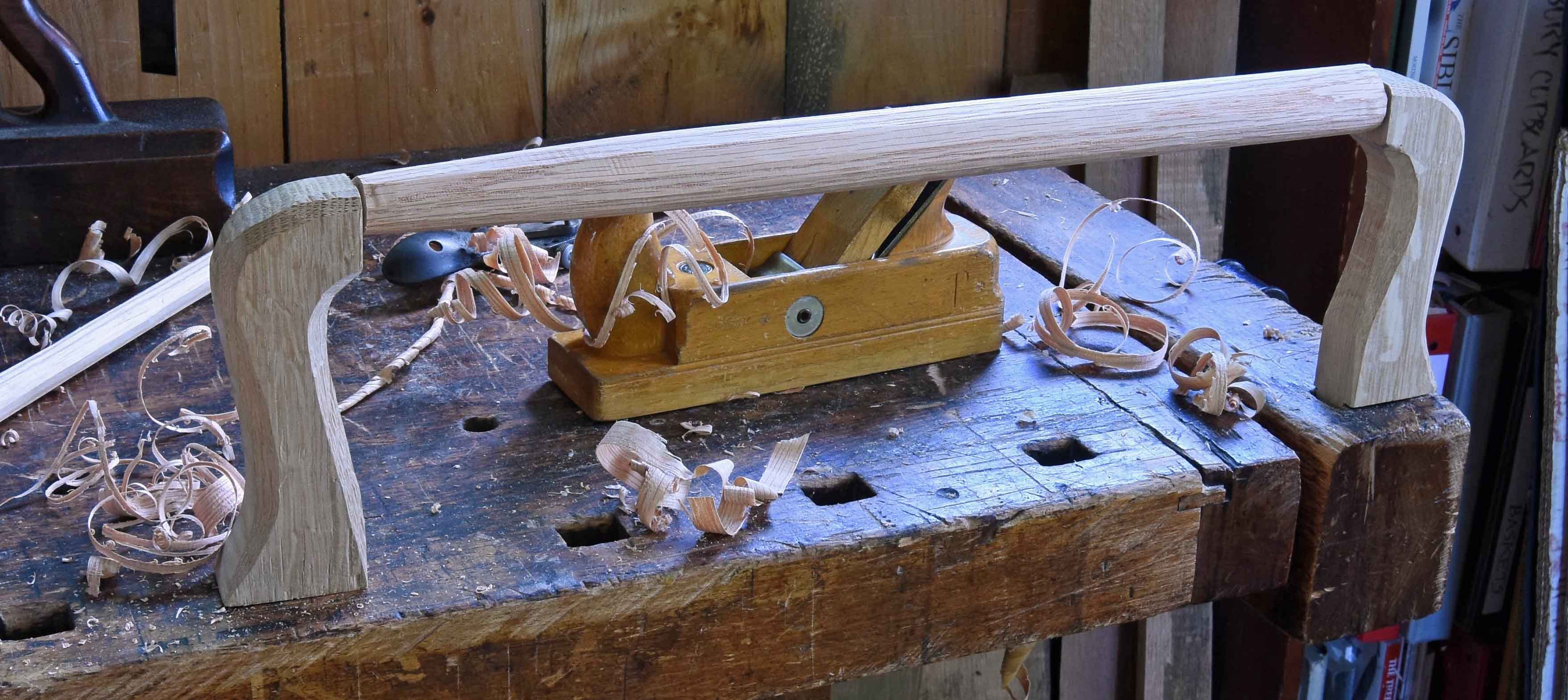
Holding stuff for drawknife work
a few alternatives

Sometimes at bedtime I have what my mother-in-law called “2-page eyes” - I’m trying to read, but fall asleep before I get anywhere. But - throughout the day I’m still reading scads and scads of stuff pertaining to my Craft Genealogy project - the one about the people who taught me woodworking. Lately much of that time has been spent on Jennie Alexander’s notebook. I recently estimated that I have more than 2,500 pages of JA’s notes- and that’s not all of them! I’m not going to run out anytime soon.
I’m getting closer to knowing about Alexander’s “handle clamp” or whatever she called it. It’s strictly a distraction. My run down this rabbit hole is pointless, but interesting (to me, anyway.) Here’s a clearer (but still hard to completely decipher) picture of Jennie Alexander with her homemade alternative to a shaving horse.
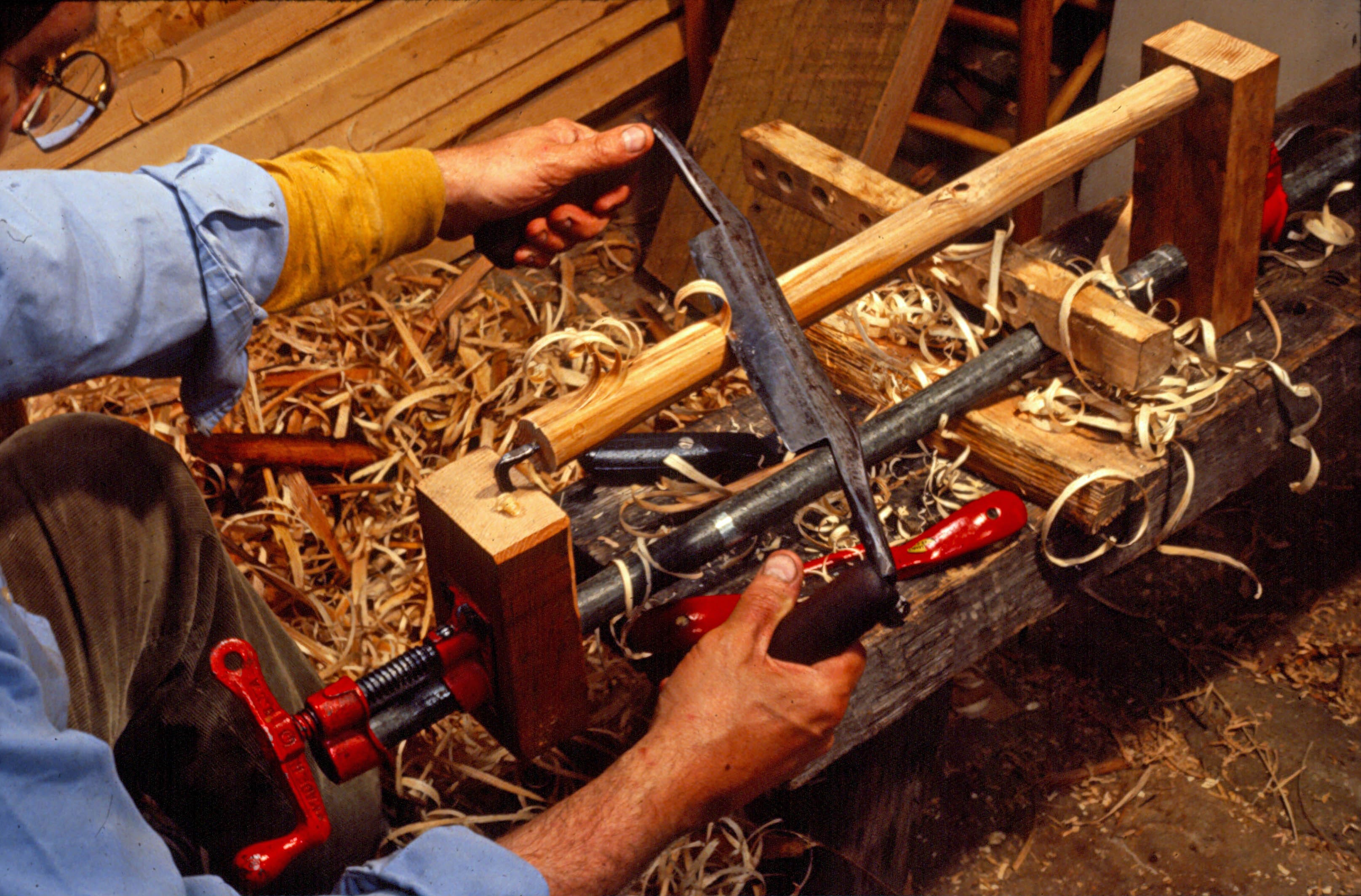
The idea here is to have an adjustable clamp that pinches chair parts - rungs & posts - no talk of slats in this system - between two “points” - like the way a turning is captured on a lathe. She didn’t use this much, didn’t use it very long. The impetus wasn’t a lack of a shaving horse on her part, it was about finding ways to get people up & running without a great deal of fuss. I’m not sure this particular item really served that function. I wonder if anyone ever made one?
She had a shaving horse that she built from a plank found on the streets of Baltimore. She designed that by mis-reading a poorly-reproduced English photo. She tells that story in the Lost Art Press 3rd edition of the book. Some time later she redesigned a shaving horse and together we had an article in the magazine Woodwork on that version. I still use mine now, though it’s had a couple parts replaced over the last 30+ years.
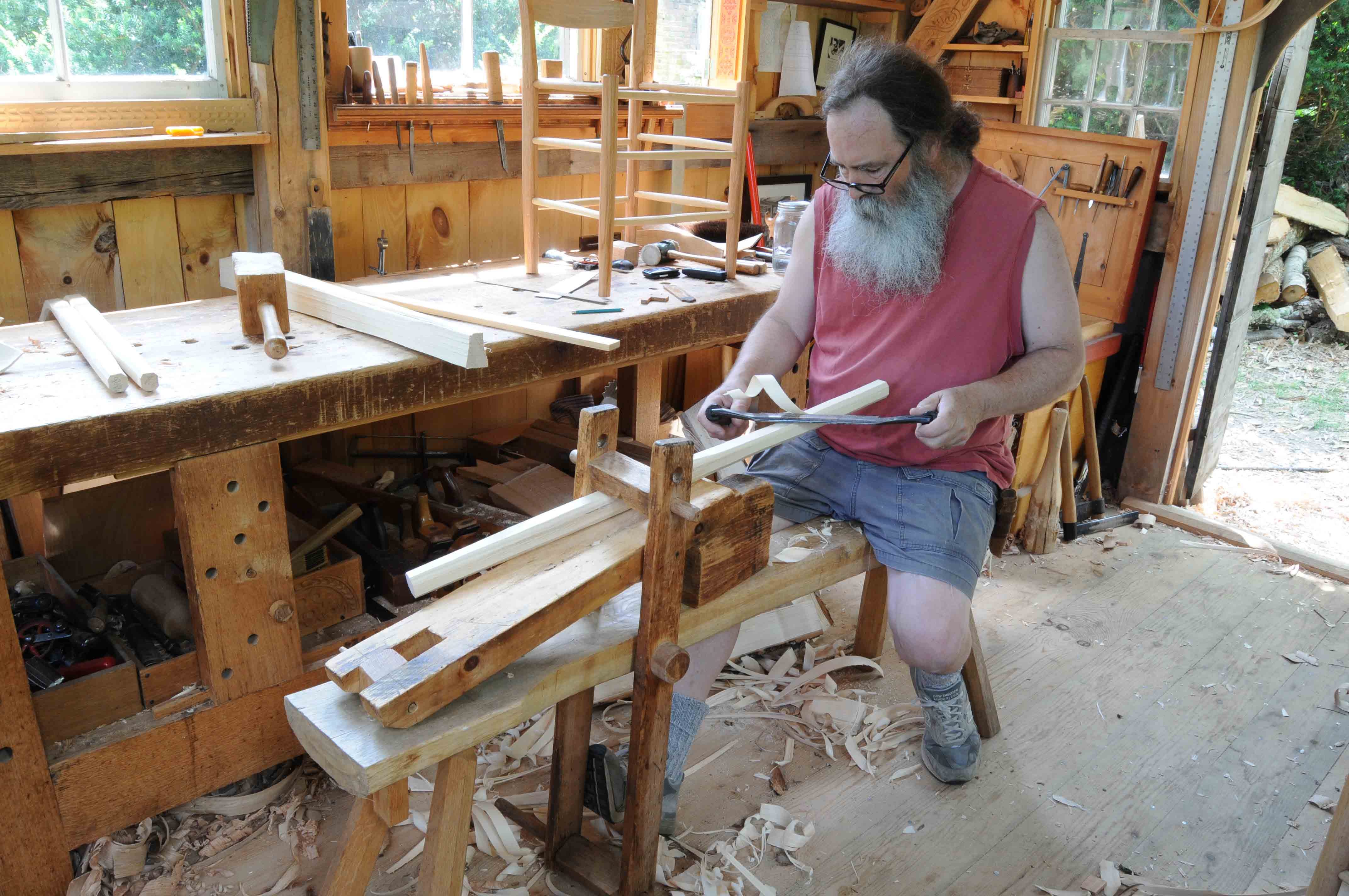
One thing Alexander always came back to was playing with language. She liked to make up words and names, she liked to play with phrases that she insisted were derived from woodworking - “let the chips fall where they may...” - that sort of thing. One she often talked about was “fiddlesticks” I never got the fiddlesticks references…still don’t. But now I know how she got onto this one. In a Jan 18, 1979 letter to Drew Langsner, ahead of their first class together on chairmaking, she wrote about a “fiddle” for shaving chair parts & sketched it for Drew to make some. (I assume he never did, he had plenty of shaving horses…)
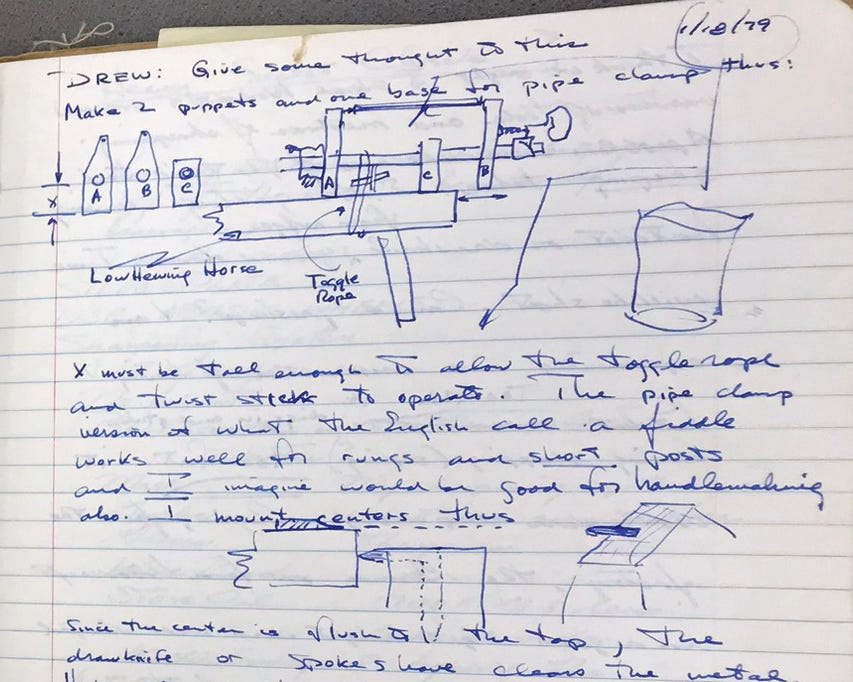
It took me a while to realize that the scribblings on the top right corner were a stick-figure woodworker, sitting on a stump to use the clamp with a drawknife. The figure’s head encircles the letter’s date. Here’s what the text says:
Make 2 poppets and one base for pipe clamp thus:
X must be tall enough to allow the toggle rope and twist stick to operate. The pipe clamp version of what the English call a fiddle works well enough for rungs and short posts and I imagine would be good for handlemaking also. I mount centers thus:
Since the center is flush to the top, the drawknife or spokeshave clears the metal. You could make the clamp quicker to adjust by making bases C & C’ and making the bottoms of A& B shorter. This way I could slide up and down the pipe freely w/o loosening the toggle. ? Is it worth the trouble? Remember in chairmaking there are only 3 or 4 lengths involved.
JA often babbled on about “fids” and “fiddlesticks” - I learned to tune it out, after I tried arguing with her for a few years. Ever try to argue with a lawyer? Not much profit in it. Recently, I finally found her source for the term in one of her letters to John Kelsey, the editor of Make a Chair from a Tree’s first edition -
I am writing an article on chisel handle making for Fine Woodworking. I am trying to introduce the 20th Century to the drawknife and the fiddle (or handle clamp). Remember that you make fiddle sticks on a fiddle. Salaman p. 513-514.
So now I have her reference. Salaman means R.A. Salaman’s Dictionary of Woodworking Tools. I have the revised edition published by Taunton Press in 1990. Salaman has precious little to say about the “fiddle” - but does illustrate one in his discussion of wheelwright’s tools, under the heading “Spoke Holders” - specifically ones found in the “home counties” i.e. those counties around London :
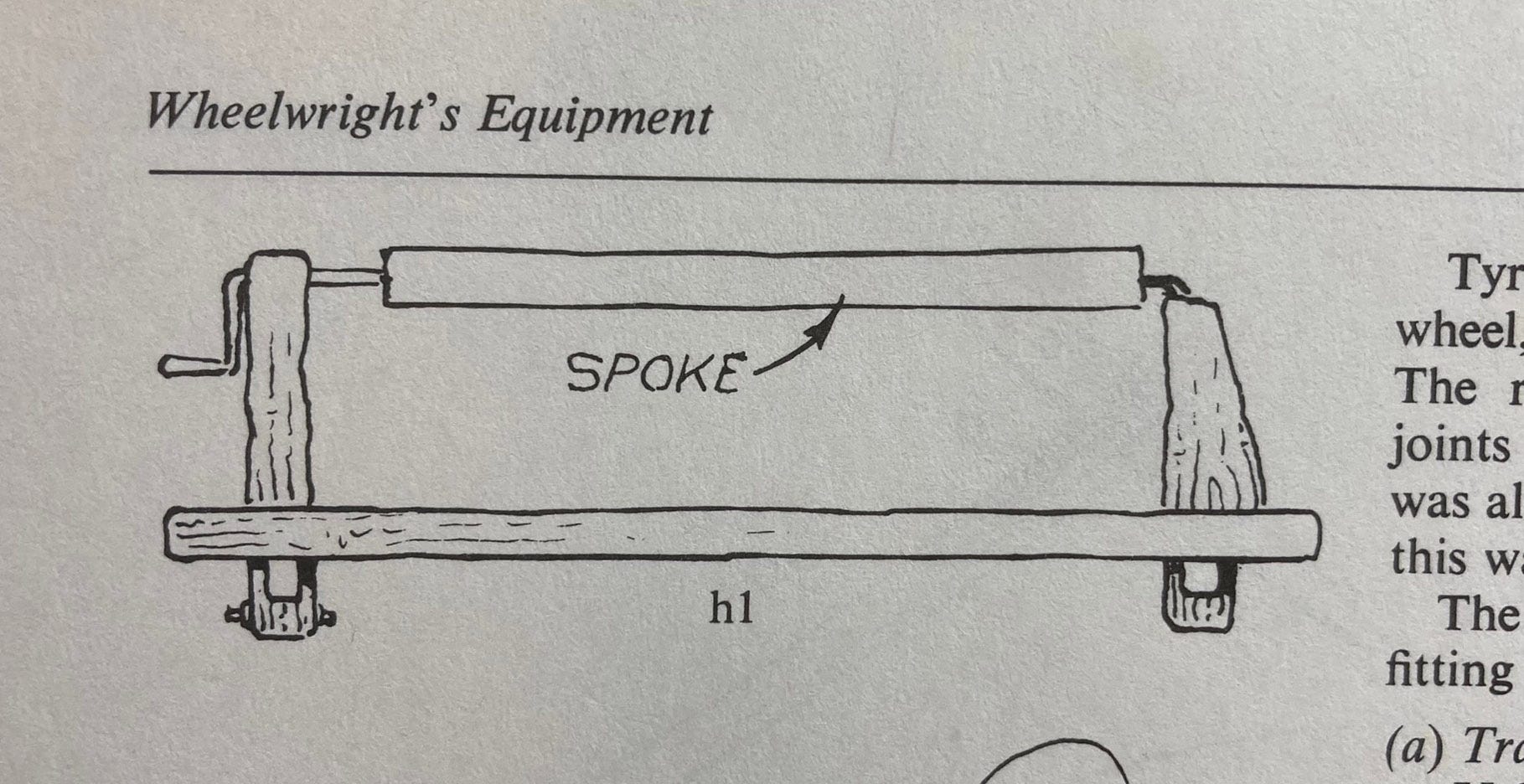
The full text amounts to this:
The Fiddle. The spoke is pivoted between lathe-like centers, one of which is set upon a handscrew. It can thus be held tight enough for trimming and yet turned conveniently by the user’s hand. (The same device is used by handle makers.)
I skimmed Sturt’s The Wheelwright’s Shop but didn’t readily find a reference to fiddles. Salman’s illustration is very clear - except for where or how this apparatus is secured or fixed in place for working. There seems to be tenons running through the platform - so it can’t sit on a bench this way.
The handle article never happened. But JA did “fiddle” around with handle-making for ages & ages. For some of that work she applied the Estonian end-vise pole lathe idea -that’s a whole ‘nother (related) story - I covered it here https://peterfollansbeejoinerswork.substack.com/p/jennie-alexanders-end-vise-pole-lathe
And all of this reminds me of the German bench dogs I learned about from reading Daniel O’Hagan’s notes. I’ve written about them before, but it was when this blog was brand-new. So maybe it’s worth another look.